Winter 2026 Ml Workshop Survey Responses

Number of responses

Code
library(tidyverse)
library(bslib)
library(shiny)
library(bsicons)
source("scripts/helper_functions.R")

# list of workshop IDs to filter results
workshops <- c("2026-02-02-ucsb-ml")

results <- read_csv("data-joined/all_workshops.csv") %>% 
  filter(workshop %in% workshops)
  
# Fix comma separator
results <- results %>% 
  mutate(findout_select.pre = str_replace_all(
  findout_select.pre, 
  "Twitter, Facebook, etc.", 
  "Twitter; Facebook; etc."))

pre_survey <- results %>%
  select(ends_with(".pre"))

post_survey <- results %>%
  select(ends_with(".post"))

n_pre <- sum(apply(post_survey, 1, function(row) all(is.na(row))))
n_post <- sum(apply(pre_survey, 1, function(row) all(is.na(row))))
n_total <- nrow(results)
n_both <- nrow(results) - n_pre - n_post

layout_columns(
  value_box(
    title = "Total responses", value = n_total, ,
    theme = NULL, showcase = bs_icon("people-fill"), showcase_layout = "left center",
    full_screen = FALSE, fill = TRUE, height = NULL
  ),
  value_box(
    title = "Both pre- and post-", value = n_both, , theme = NULL,
    showcase = bs_icon("arrows-expand-vertical"), showcase_layout = "left center",
    full_screen = FALSE, fill = TRUE, height = NULL
  ),
  value_box(
    title = "Only pre-workshop", value = n_pre, ,
    theme = NULL, showcase = bs_icon("arrow-left-short"), showcase_layout = "left center",
    full_screen = FALSE, fill = TRUE, height = NULL
  ),
  value_box(
    title = "Only post-workshop", value = n_post, , theme = NULL,
    showcase = bs_icon("arrow-right-short"), showcase_layout = "left center",
    full_screen = FALSE, fill = TRUE, height = NULL
  )
)

Total responses

16

Both pre- and post-

4

Only pre-workshop

8

Only post-workshop

4
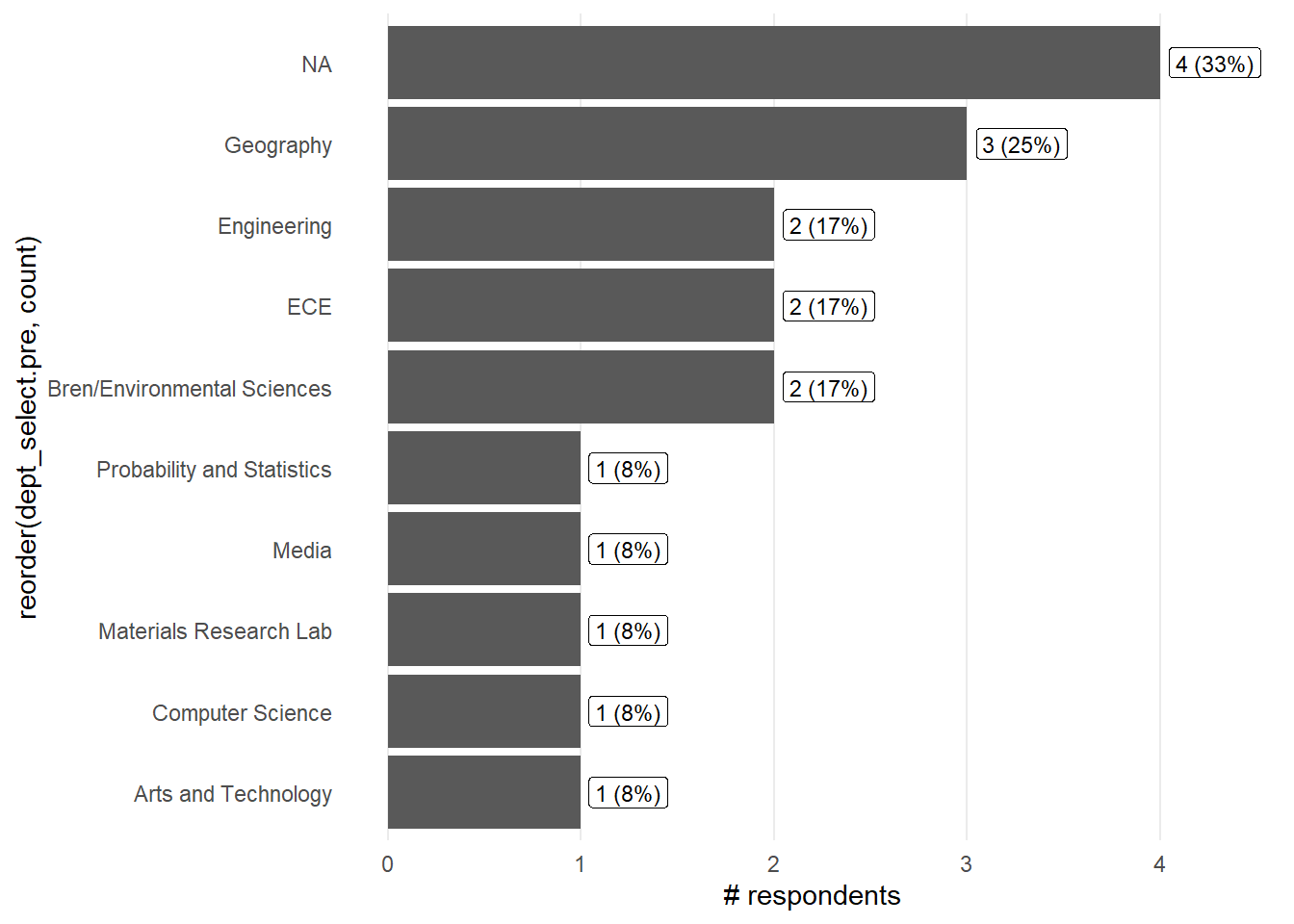
Departments

Code
depts <- results %>% select(dept_select.pre) %>% 
  separate_rows(dept_select.pre, sep=",") %>%
  mutate(dept_select.pre = str_trim(dept_select.pre)) %>%
  count(dept_select.pre, name = "count") %>% 
  mutate(percent = (count / (n_total - n_post)) * 100,
         text = sprintf("%.0f (%.0f%%)", count, percent))

ggplot(depts, aes(y=reorder(dept_select.pre, count), x=count)) +
    geom_col() +
    geom_label(aes(label = text, hjust = -0.1),
               size = 3) +
    labs(x = "# respondents") +  
    theme_minimal() +
    theme(
      panel.grid.minor = element_blank(),
      panel.grid.major.y = element_blank()
      ) +
    expand_limits(x = c(0,max(depts$count)*1.1))

“Other” Departments

Code
other_depts <- results %>% 
  count(dept_other.pre, name = "count") %>% 
  drop_na() %>% 
  mutate(percent = (count / (n_total - n_post)) * 100,
         text = sprintf("%.0f (%.0f%%)", count, percent))

ggplot(other_depts, aes(y=reorder(dept_other.pre, count), x=count)) +
    geom_col() +
    geom_label(aes(label = text, hjust = -0.1),
               size = 3) +
    labs(x = "# respondents") + 
    theme_minimal() +
    theme(
      panel.grid.minor = element_blank(),
      panel.grid.major.y = element_blank()
      ) +
    expand_limits(x = c(0,max(other_depts$count)*1.1))

Current occupation / Career stage

Code
ocup <- results %>% select(occupation.pre) %>% 
  separate_rows(occupation.pre, sep=",") %>%
  mutate(occupation.pre = str_trim(occupation.pre)) %>%
  count(occupation.pre, name = "count") %>% 
  drop_na() %>% 
  mutate(percent = (count / (n_total - n_post)) * 100,
         text = sprintf("%.0f (%.0f%%)", count, percent))

ggplot(ocup, aes(y=reorder(occupation.pre, count), x=count)) +
    geom_col() +
    geom_label(aes(label = text, hjust = -0.1),
               size = 3) +
    labs(x = "# respondents") + 
    theme_minimal() +
    theme(
      panel.grid.minor = element_blank(),
      panel.grid.major.y = element_blank()
      ) +
    expand_limits(x = c(0,max(ocup$count)*1.2))

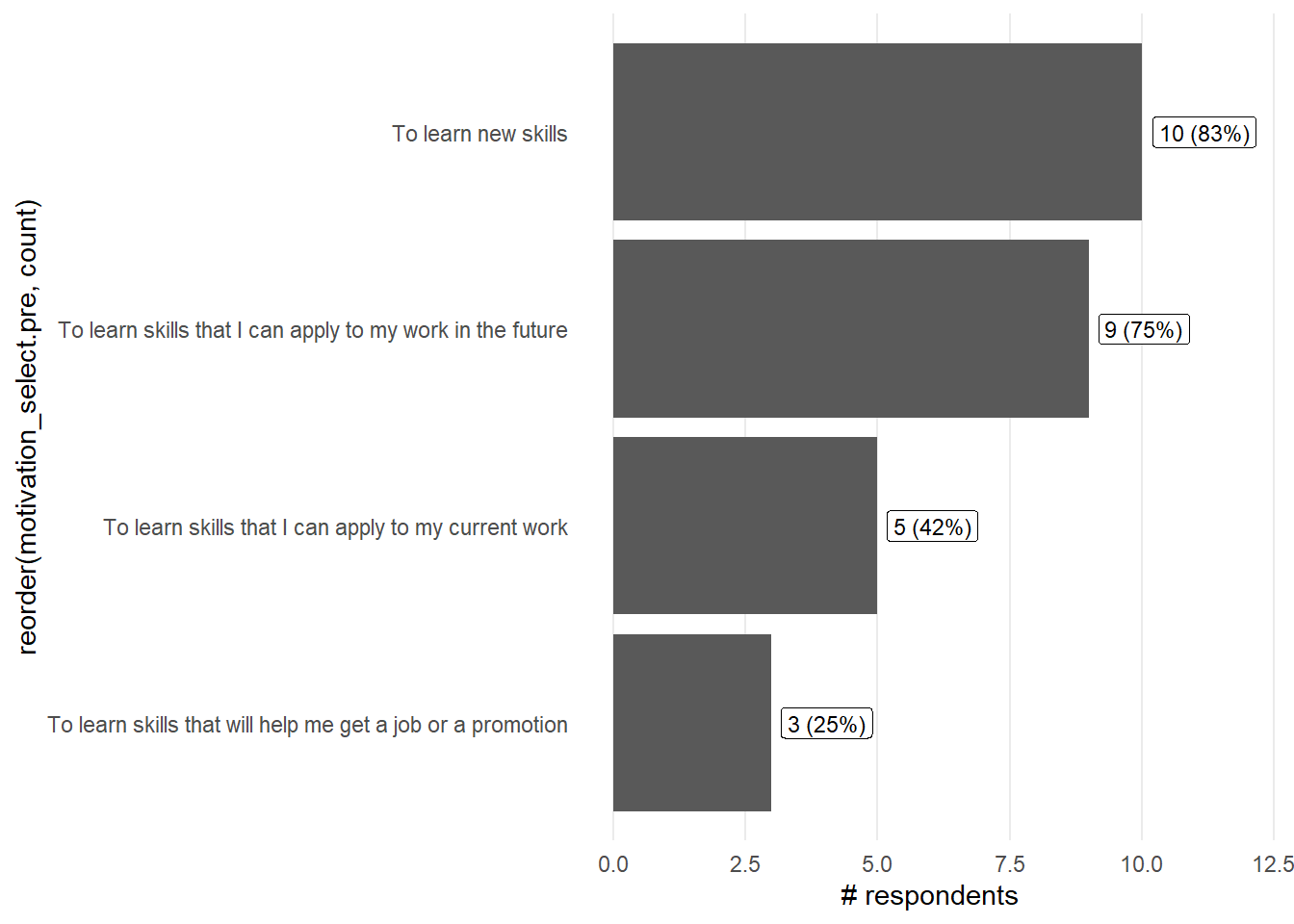
Motivation - Why are you participating in this workshop?

Code
motiv <- results %>% select(motivation_select.pre) %>% 
  separate_rows(motivation_select.pre, sep=",")  %>% 
  mutate(motivation_select.pre = str_trim(motivation_select.pre)) %>%
  count(motivation_select.pre, name = "count") %>% 
  drop_na() %>% 
  mutate(percent = (count / (n_total - n_post)) * 100,
         text = sprintf("%.0f (%.0f%%)", count, percent))

ggplot(motiv, aes(y=reorder(motivation_select.pre, count), x=count)) +
    geom_col() +
    geom_label(aes(label = text, hjust = -0.1),
               size = 3) +
    labs(x = "# respondents") + 
    theme_minimal() +
    theme(
      panel.grid.minor = element_blank(),
      panel.grid.major.y = element_blank()
      ) +
    expand_limits(x = c(0,max(motiv$count)*1.2))

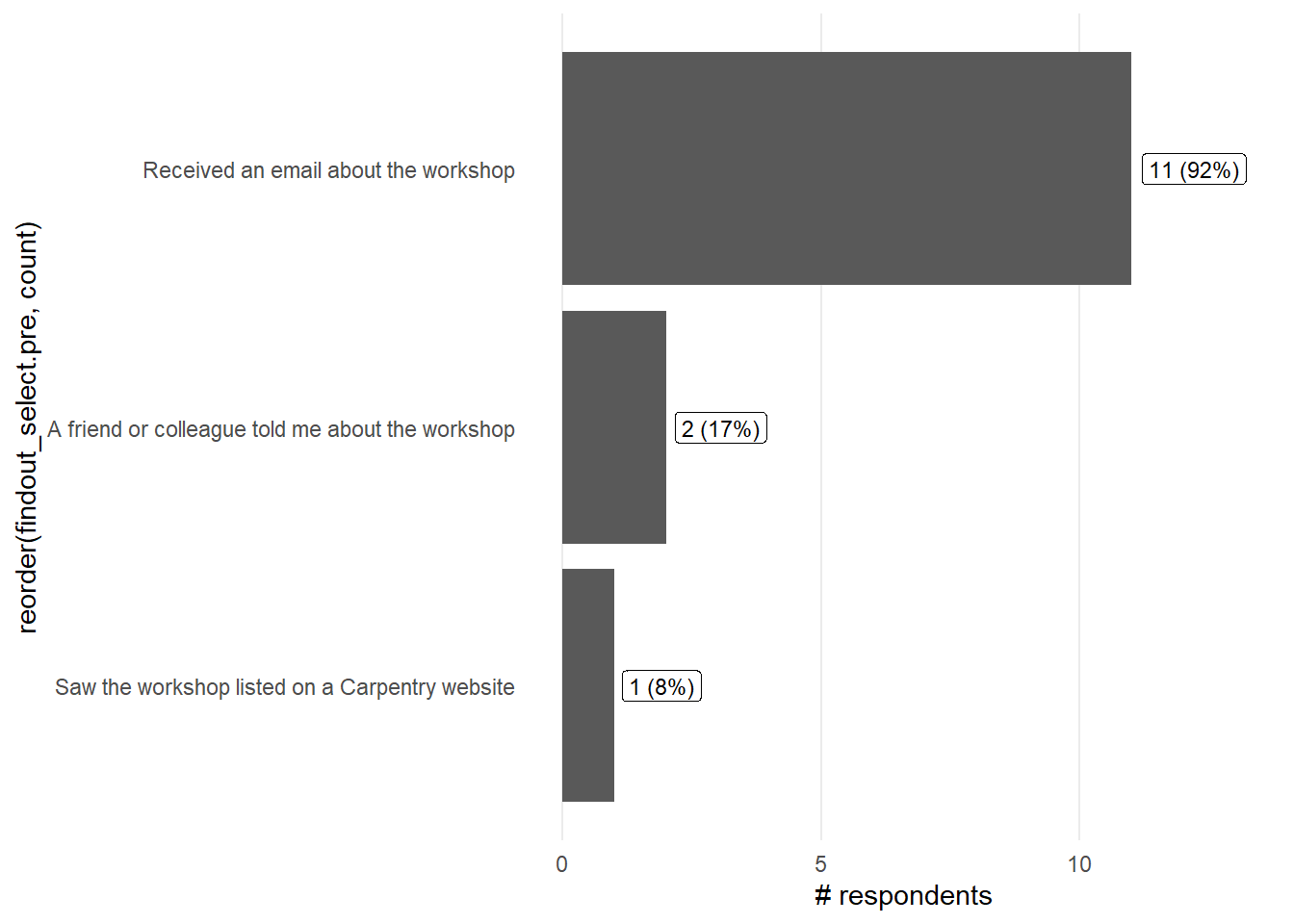
How did you find out about this workshop?

Code
findw <- results %>% select(findout_select.pre) %>% 
  separate_rows(findout_select.pre, sep=",")  %>% 
  mutate(findout_select.pre = str_trim(findout_select.pre)) %>%
  count(findout_select.pre, name = "count") %>% 
  drop_na() %>% 
  mutate(percent = (count / (n_total - n_post)) * 100,
         text = sprintf("%.0f (%.0f%%)", count, percent))

ggplot(findw, aes(y=reorder(findout_select.pre, count), x=count)) +
    geom_col() +
    geom_label(aes(label = text, hjust = -0.1),
               size = 3) +
    labs(x = "# respondents") + 
    theme_minimal() +
    theme(
      panel.grid.minor = element_blank(),
      panel.grid.major.y = element_blank()
      ) +
    expand_limits(x = c(0,max(findw$count)*1.2))

What you most hope to learn?

Code
results %>% group_by(workshop) %>% 
  select(workshop, hopes.pre) %>% 
  drop_na()
workshop hopes.pre
2026-02-02-ucsb-ml I am in the mechanical engr department and I actively use python for my work for geometric statistical analysis on cell shapes. My advisor now would like me to begin to incorporate ML with my geometric statistics…. so I am hoping to gain a better sense of what that really means, what it would look like, how ML models are actually built, and as an engineer, how I can implement/ build ML tools in python. :) Thank you for your time in. advance!
2026-02-02-ucsb-ml new skills for machine learning that will hopefully allow me to build enhanced earth observation datasets or build improved models for drought analysis
2026-02-02-ucsb-ml How to incorporate ML in to my own research
2026-02-02-ucsb-ml Experience with machine learning-based analysis; experience with python
2026-02-02-ucsb-ml I hope to learn more about machine learning during this workshop.
2026-02-02-ucsb-ml An introduction to machine learning processes that I can incorporate into my research workflow.
2026-02-02-ucsb-ml Deeper understanding of machine learning projects
2026-02-02-ucsb-ml The basics of machine learning. Enough information to build on and to be able to chat about machine learning with peers and potential employers

Learning environment in the workshop

Code
orderedq <- c("Strongly Disagree", "Somewhat Disagree", "Neither Agree or Disagree","Somewhat Agree", "Strongly Agree")
addNA(orderedq)
Code
agree_questions <- results %>% 
  select(join_key, agree_apply.post,    agree_comfortable.post, agree_clearanswers.post,
         agree_instr_enthusiasm.post, agree_instr_interaction.post, agree_instr_knowledge.post
) %>% 
  filter(!if_all(-join_key, is.na))

n_agree_questions <- nrow(agree_questions)
  
agree_questions <- agree_questions %>%
  pivot_longer(cols = -join_key, names_to = "Question", values_to = "Response") %>% 
  mutate(Response = factor(Response, levels = orderedq),
         Question = recode(Question,
                     "agree_apply.post" = "Can immediatly apply 
 what they learned",
                     "agree_comfortable.post" = "Comfortable learning in 
 the workshop environment",
                     "agree_clearanswers.post" = "Got clear answers 
 from instructors",
                     "agree_instr_enthusiasm.post" = "Instructors were enthusiastic",
                     "agree_instr_interaction.post" = "Comfortable interacting 
 with instructors",
                     "agree_instr_knowledge.post" = "Instructors were knowledgeable 
 about the material"
      ))

summary_data <- agree_questions %>%
  count(Question, Response, name = "count") %>% 
  mutate(percent = (count / n_agree_questions) * 100,
         text = sprintf("%.0f (%.0f%%)", count, percent))

ggplot(summary_data, aes(x = Question, y = count, fill = Response)) +
  geom_col(position = "fill", color = "black", show.legend = TRUE) +
  scale_y_continuous(labels = scales::percent_format()) + 
  scale_fill_manual(values = c("Strongly Disagree" = "#d01c8b", 
                               "Somewhat Disagree" = "#f1b6da", 
                               "Neither Agree or Disagree" = "#f7f7f7", 
                               "Somewhat Agree" = "#b8e186", 
                               "Strongly Agree" = "#4dac26"), 
                    na.translate = TRUE, na.value = "#cccccc", 
                    breaks = orderedq, drop = FALSE) +
  geom_text(aes(label = text), size = 3,
             position = position_fill(vjust = 0.5)) +
  labs(y = "# respondents (Percentage)", fill = "Responses",
       subtitle = paste0("Number of responses: ", n_agree_questions)) +
  theme_minimal() +
  theme(axis.text.x = element_text(angle = 45, hjust = 1),
        plot.subtitle = element_text(hjust = 0.5, size = 12))

How an instructor or helper affected your learning experience

Code
results %>% 
  group_by(workshop) %>% 
  select(workshop, instructor_example.post) %>%
  drop_na()
workshop instructor_example.post
2026-02-02-ucsb-ml This workshop was SO incredibly useful and helpful. Both of the instructors (Jose and Tian) thoroughly offered all of my questions and provided useful one-on-one feedback and guidance. Both instructors were patient, understanding, and incredibly knowledgable. The pace was perfect and I appreciate how the instructors and helpers were both asking if we had questions throughout. this was by far the most useful ML class I have ever taken. I would take this every week if I could because I learned so much and it was so effective and useful. It will be directly relevant for my research. Thank you!!
2026-02-02-ucsb-ml they were able to answer some questions that people raised that were more specific to their expertise.
2026-02-02-ucsb-ml prompt assistance when in need & invitations to ask questions
2026-02-02-ucsb-ml Very helpful answering questions and going in depth
2026-02-02-ucsb-ml clearly answered a question that i had provided on my sticky note from day 1

Skills and perception comparison

Code
# Calculate mean scores and make graph for all respondents (only_matched=FALSE)
tryCatch(
  {
mean_nresp <- get_mean_scores_nresp(results, only_matched=FALSE)
graph_pre_post(mean_nresp$mean_scores, mean_nresp$n_resp_pre, mean_nresp$n_resp_post, mean_nresp$n_resp_pre_post, only_matched=FALSE)
},
error = function(cond) {
message("Could not do the plots as there are no pre or post results to show")
}
)

Code
# Calculate mean scores and make graph for only matched respondents in pre and post (only_matched=TRUE)
tryCatch(
  {
mean_nresp <- get_mean_scores_nresp(results, only_matched=TRUE)
graph_pre_post(mean_nresp$mean_scores, mean_nresp$n_resp_pre, mean_nresp$n_resp_post, mean_nresp$n_resp_pre_post, only_matched=TRUE)
},
error = function(cond) {
message("Could not do the plots as there are no pre or post results to show")
}
)

Workshop Strengths

Code
results %>% 
  group_by(workshop) %>% 
  select(workshop, workshop_strengths.post) %>% 
  drop_na()
workshop workshop_strengths.post
2026-02-02-ucsb-ml The content was useful and applicable, the topic breadth was perfect, it was the perfect balance of application and theory, and the instructors were knowledgeable and patient.
2026-02-02-ucsb-ml it was a great exposure to some of the ML concepts and how to implement them in python. it gave me things to think about for how i might implement some of these things in my work, which is much farther along than i was before the course.
2026-02-02-ucsb-ml good materials, helpful introduction
2026-02-02-ucsb-ml well-made jupyter notebooks
2026-02-02-ucsb-ml Good intro to libraries and setting up code to do ML analysis
2026-02-02-ucsb-ml Very clear and good balance of theory and practice
2026-02-02-ucsb-ml hands on, experienced instructors, opportunities to ask questions

Ways to improve the workshop

Code
results %>% 
  group_by(workshop) %>% 
  select(workshop, workshop_improved.post) %>% 
  drop_na()
workshop workshop_improved.post
2026-02-02-ucsb-ml The only improvement would be to have more of these workshops because they were so useful!
2026-02-02-ucsb-ml it was rushed, but i think that’s alright to get people some exposure to the topic. they were very good at dealing with a number of different folks who had technical issues.
2026-02-02-ucsb-ml design it so that we could cover more of the image convolution material. a more useful intro o that could have been achieved with ~30 minutes.
2026-02-02-ucsb-ml pace could be a bit faster, maybe less specific details
2026-02-02-ucsb-ml If the code is mostly set to be run with no mods, spend less time going over coded and more time and theory
2026-02-02-ucsb-ml this is difficult with a broad audience, but it would have been neat to see more specific examples that would apply to my STEM research

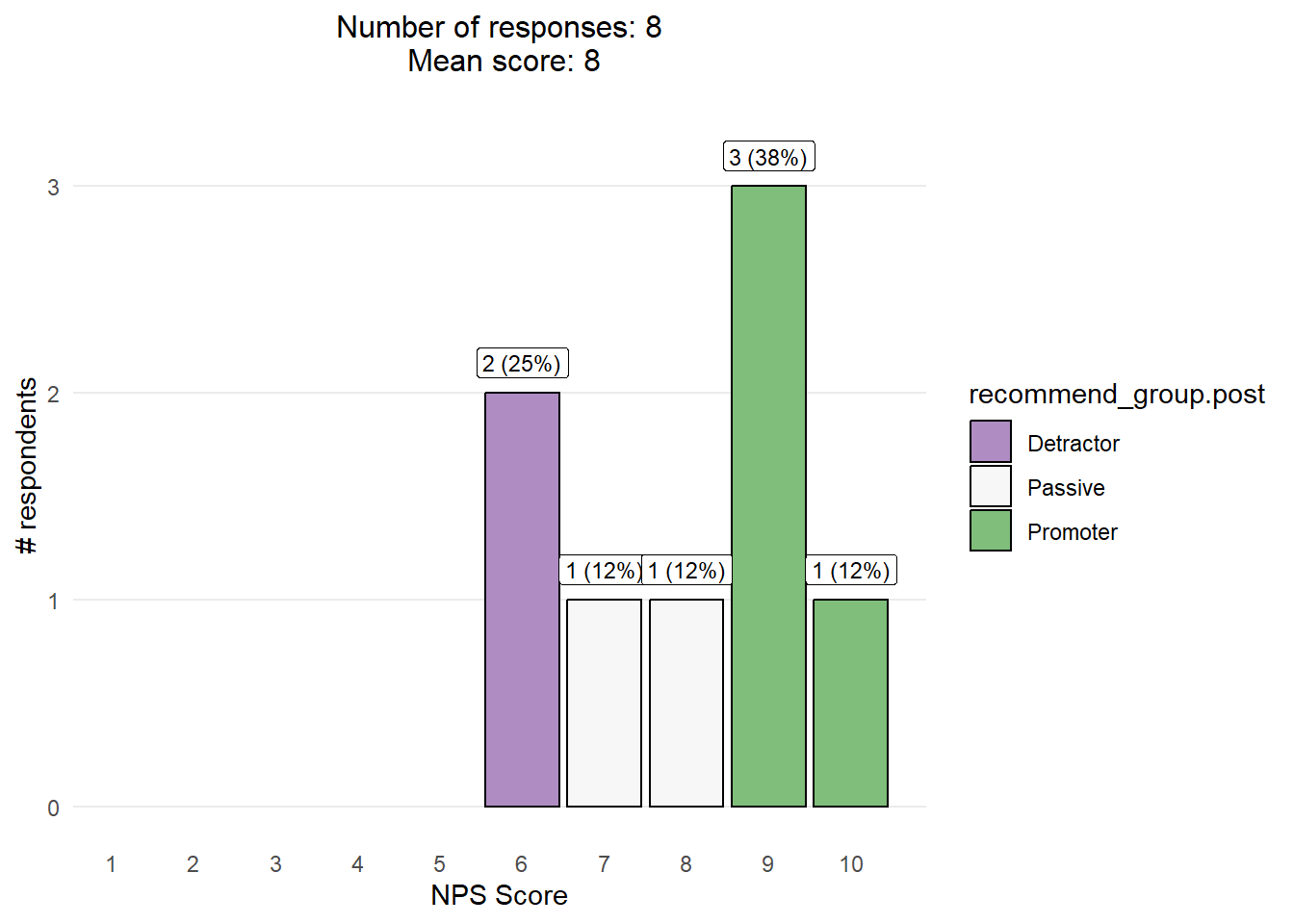
How likely are you to recommend this workshop? Scale 0 - 10

Code
orderedq <- c("Detractor", "Passive", "Promoter")

nps <- results %>% 
  count(recommend_group.post, recommende_score.post, name = "count") %>% 
  drop_na() %>% 
  mutate(recommend_group.post = factor(recommend_group.post, levels = orderedq),
         percent = (count/sum(count)) * 100,
         text = sprintf("%.0f (%.0f%%)", count, percent))

nps %>% 
ggplot(aes(x=recommende_score.post, y=count, fill=recommend_group.post)) +
  geom_col(color="black", show.legend = TRUE) +
  scale_fill_manual(values = c("Detractor" = "#af8dc3", "Passive" = "#f7f7f7", "Promoter" = "#7fbf7b"), breaks = c("Detractor", "Passive", "Promoter"), drop = FALSE) +
  geom_label(aes(label = text, vjust = -0.5), fill = "white", size= 3) +
  scale_x_continuous(breaks = 1:10) +
  labs(x = "NPS Score", y = "# respondents", subtitle = paste0("Number of responses: ", sum(nps$count), "
 Mean score: ", format(weighted.mean(nps$recommende_score.post, nps$count), digits = 3))) +
  theme_minimal() +
  theme(
    panel.grid.minor = element_blank(),
    panel.grid.major.x = element_blank(),
    plot.subtitle = element_text(hjust = 0.5, size = 12)
  ) +
  expand_limits(x = c(1,10),
                y = c(0, max(nps$count)*1.1))

Topic Suggestions

Code
results %>% 
  group_by(workshop) %>% 
  select(workshop, suggest_topics.post) %>% 
  drop_na()
workshop suggest_topics.post
2026-02-02-ucsb-ml Unsupervised machine learning :); Or anything else related to machine learning! This is easily the most applicable ML course I’ve taken (others are too theoretical/mathematically dense).
2026-02-02-ucsb-ml thanks, it was great!
2026-02-02-ucsb-ml unsupervised learning